Friday, 14 June 2013

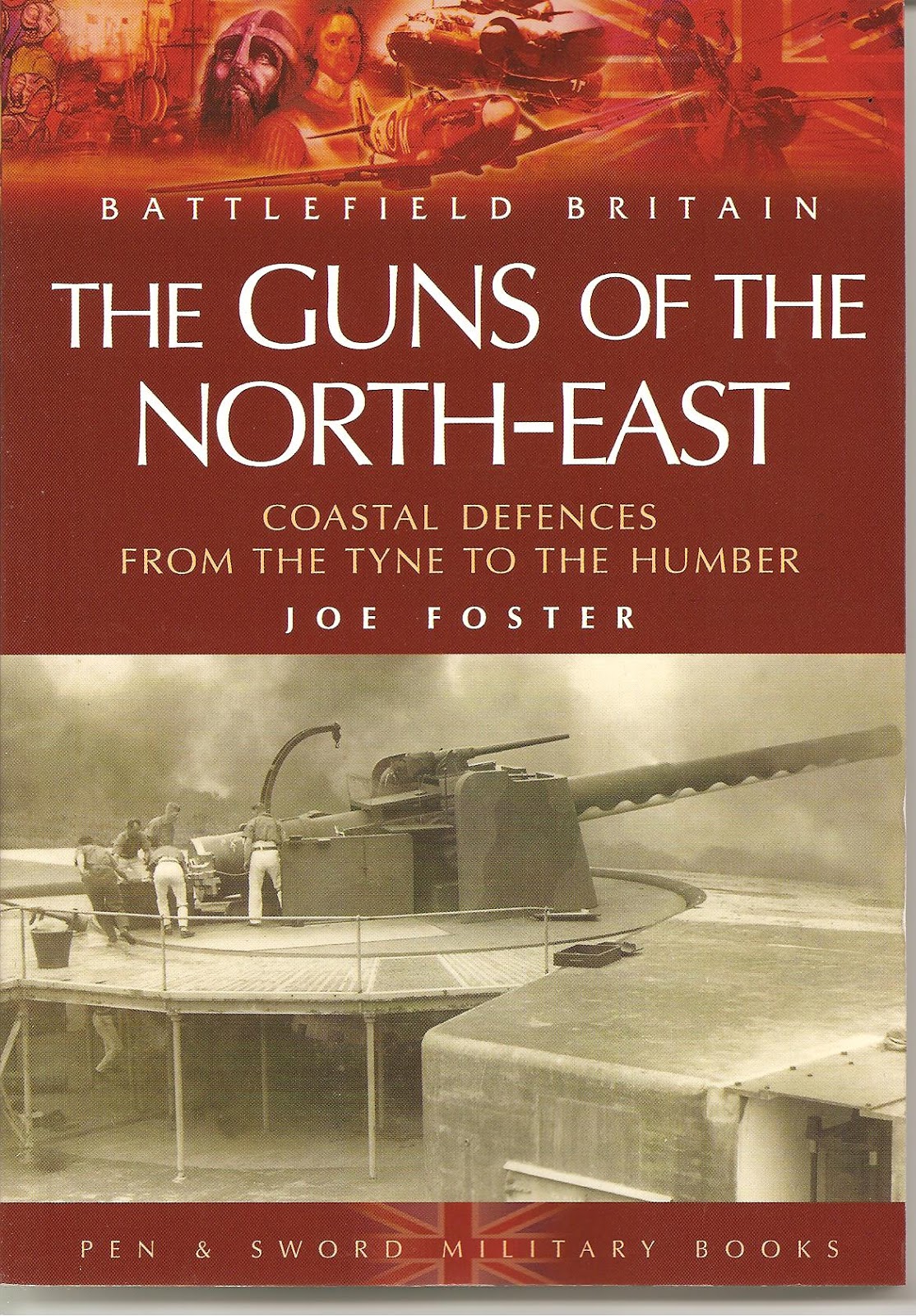
"The Guns of the North-East" by Joe Foster


Recently I wrote about my plans to visit more fortresses in Britain and my reading of "Fortress Britain" by Anthony Saunders. I came across this book by Joe Foster whilst looking for further reading, as the York University of the Third Age (U3A) Military History Group were planning a visit to Heugh Battery in Hartlepool.

The book covers the East coast of England from Bamborough to the Humber, the forts and batteries built and the raising of the volunteer, militia artillery units for the period 1850 - 1956 to man the forts, along with infantry and yeomanry. This was a separate strategy to that of Southern England known as the Palmerston Forts, although both strategies suffered from an initial burst of enthusiasm but then prolonged budget restrictions.

The book has five chapters:-

1.History, from establishment to disbandment.

2. Coast Artillery, the cannons installed.

3. Gunners, their recruitment, from Victorian period, through WW1  and WW2 and some personal accounts.

4. The Bombardment of Hartlepool, by ships of the German Imperial Navy in December 1914 and the exchanges with Heugh Battery.

5. Gazetteer.

This is a good book that sets the strategy of coastal defence in the UK in a local context. Also the technical aspects are very well explained, such as the difference between MLR (Muzzle Loading Rifled) and RML (Rifled Muzzle Loading). The gazetteer is going to be very useful for planning some outings, I am looking forward to it.

Next - in between walks, I must get back to some French History, I have a biography of Napoleon Bonaparte and two further Napoleonic period histories plus I have found of two books I have wanted to read for some time, Anthony Clayton's "France, Soldiers and Africa" and Lee Kennett's "The French Forces in America 1780 - 1783". Still waiting for the copy of Stephen Brumwell's biog of Wolfe from Amazon UK.

Saturday, 8 June 2013

Monument to the Battle of Marston Moor

In this part of Yorkshire, it's hard to avoid history. Yesterday, my partner wanted to spend some time with her newly purchased horse at the stables in Tockwith, about fifteen miles from York. I took my bicycle so I could get some exercise and some sunshine.

Between Tockwith and Long Marston is the English Civil War battlefield of Marston Moor. In the spring of 1644, Parliamentary forces were besieging the City of York. Prince Rupert led a Royalist force into Yorkshire to try to lift the siege. On 2nd July 1644, Parliamentary and Coventanter forces (22,500 men) under Fairfax defeated the Royalist forces (17,000 men) commanded by Prince Rupert. Parliamentary army lost 300 men. The Royalists lost 4,000 men killed, 1,500 prisoners. A bloody day but a great one for the Parliamentary cause. Two weeks later, the Royalist garrison in York surrendered the city and the Royalists effectively gave up the North of England.


Tuesday, 4 June 2013

Battle of Magenta 4th June 1859

Today is the 154th anniversary of the Battle of Magenta during the Second War for Italian independence, between French, Sardinian and other allied forces opposing the Austrian army of occupation.

The war lasted about three months, but many historians believe this is the first major use of railways to transport troops and of rifled artillery.
This map is from Visual-Italy.com, Magenta is centre-stage.

Napoleon III had crossed the Ticoni and outflanked the Austrians under General Gyulai.

 This is a painting of the Imperial Guard, under General Mellinet, seizing the bridge (Ponte Nuovo) over the canal, the Naviglio Grande and holding it for several hours until reinforcements arrived. The painting is by Charpentier and was painted in 1860. I believe it is now in the Musée d'Armée, Les Invalides.

At the end of the day, the French and allied troops had pushed the Austrians out of Magenta and gained a victory.
The Battle of Magenta by Induno, painting in Les Invalides

Marshall MacMohan was made Duke of Magenta, unknown photographer


Saturday, 1 June 2013

"Fortress Britain" by Andrew Saunders


Last year I made two very good, very interesting visits to Fort Nelson in Portsmouth. This has prompted me to reconsider my approach to fortification in Britain and to plan more visits to more sites. This is outside my usual remit of French military history but it does reflect an aspect of French foreign policy for five hundred years.

This book was listed in a few publications as being a good reference study, essential for anyone to understand British fortification policy. It was published in 1981 and not repeated, so I watched EBay and Amazon for a few weeks to find a reasonably priced copy and I was very lucky to find one on Amazon UK.

I learnt a lot from this book. Easy to read, it is about the strategic and political issues around the construction of forts in GB. It does not explain how an artillery fort is designed, the use of angles or enfilading fire. It does explain why there was a major building programme during the reign of Henry VIII, then only sporadic building until the 1860s when a number of ports were protected by "Palmerston's Follies", in response to a new strategic policy assessment, the bolt from the blue.

Following the Glorious Revolution and the growth of mercantilism, the industrial revolution and colonisation, Britain became a major naval power. This gave rise to the Blue Water defence policy. During the 18th and 19th centuries, defence policy was based on the strength of the Royal Navy, why should we spend millions of pounds on fortifications and expanding the professional Army when no-one could amass a fleet of sufficient strength to cross the English Channel without being intercepted by the Royal Navy.

After the Crimean War, when France and UK were allies, a new scare arose, the bolt from the blue. The French Navy stole a march on the Royal Navy by developing steam powered vessels and armour plating. So, using the new railways and conscription, the French could amass an army on the Channel coast in a week and ship 100,000 men into Southern England using those armour-plated, steam-driven vessels irrespective of the weather. Could a Royal Navy fleet assemble in time and with sufficient strength to stop them?

Events on mainland Europe were to dispel this scare. Emperor Napoleon III and his army were very decisively beaten during the Franco-Prussian War, so the fort building programme was curtailed and not completed, I learnt on my visits to Fort Nelson that the fort's full compliment of artillery was never delivered.

We have been left with a number of military sites and architecture that should be visited. Henry's forts along the South coast of England, Fort George in Scotland, Hurst Castle, the forts around Portsmouth, the Isles of Wight, Jersey and Guernsey. The quantity is not European in scale, but the quality is first class. These, together with visits to Vauban, de Riviere and CORF designed forts, should keep me active for years.

First up - a visit next week to Heaugh Battery in South Shields with my local U3A Military History group, I'm really looking forward to it.

Wednesday, 29 May 2013

Fortress Visit Report No. 7 Fort de La Prée, Ile de Ré

On the Sunday of my visit to Ile de Ré, I wanted to visit the Fort de La Preé. This is along the coast to the east of St Martin de Ré. I checked on t'Internet, opens in May for the summer season. Measuring it on the map, it was 7km from my hotel so I put on new walking boots and set off.

The route was along the coastal path, dodging the cyclists, fairly straightforward, gentlish walk which I really enjoyed. Good views across the water to mainland France, the weather was windy but sunny. Good sightings of turnstones, dunlins, shelducks and a red kite. Past some WWII German works, the subject of my next report.

I arrived at the fort to find it was closed. There was no indication of why or when the fort was to open. That was a bit of a letdown. I walked around the base for some photos and walked back the 7kms to the hotel.


The fort was built in 1625 - 26 with stone recycled from the nearby derelict Abbeye des Chateliers. It is a star fort with four bastions, a surrounding wall and a small harbour. Vauban visited it in 1684 and requested some modifications with, amongst other items, new wells and a powder magazine. It was abandoned shortly after, then revived during the Revolutionary period. It was declassified in 1934. The Germans made the fort part of their island defence, but now it is in private hands. Restoration work is ongoing.

Approaching from the West, first view of the Fort.

South-west bastion.

Bastion, entrance, bastion.

WWII German work 

Harbour redan on the left, outer wall ahead.

Closer view of the redan wall.

Sally port onto the seashore
So, in the end, a nice walk, the fort was much larger than I realised from Internet photos and plans, next time I will plan better. One good thing on the walk back, I was able to observe just how well sighted the German defences were.

Monday, 27 May 2013

England v New Zealand 2nd Test

We spent Saturday at Headingly, the home of Yorkshire County Cricket Club, to see day 2 of the second  test. Actually it turned out to be day 1 of play as the Friday was a wash-out. We had a very good day, as did the England Cricket Team.

Pre-match practice

YCCC's new media centre and changing rooms

Cricket grandees

Aggers for TMS

Cook & Compton stride out to open play

First ball

Yours truly, with sun protection

Friday, 24 May 2013

Congratulations Stephen Brumwell


Three days ago I was praising Stephen Brumwell's biography "George Washington : Gentleman Warrior". This morning I see the author has won the George Washington Book Prize awarded by the George Washington College for written work on ... George Washington. $50,000, very nice.

Seriously this is a very good book, I learnt a lot. Congratulations Stephen.